| 1. Prospectus of S1 Electrical Engineering |
Competencies of Graduates of S1 Electrical Engineering
In general, S1 Electrical Engineering graduates have professional skills in the field of electrical engineering in public life, to follow and master the concepts of science and the development of new technologies in the field of electrical engineering, as well as be able to apply their knowledge for the benefit of the industry needs is local or global; has the ability to organize, design and make a decision in principle to apply their knowledge to achieve competitive results and optimal, analytical and critical thinking in the decision-making of electrical engineering problems; has the ability to apply science and engineering principles of electrical engineering and has a strong personal integrity, creative, and competent; has the ability formulate and analyze problems of electrical engineering at the same time develop the settlement system; has the ability to design a system in the field of electrical engineering; able to communicate effectively; has the ability to apply systematic, stages, methods and concepts that are needed in the field of electrical engineering.
Bachelor of Electrical Engineering basic competence is to have quality and intellectual integrity; highly competitive both academically and morally; able to adjust to the changes; realize that science is always advancing and evolving; able to browse and obtain scientific information / engineering; know how and can constantly learning; handling each problem, was able to uncover the structure and core issues and set priorities stages of completion; know and can take advantage of the usefulness of mathematics and information technology can apply science and knowledge; proficient and skilled in electrical engineering; may solve problems logically, utilize data / information available; able to use these concepts to explain things that are not / less clear; able to work independently and effort; able to actively participate in the working group; able to communicate with experts in other areas of expertise and utilize their help; able to effectively utilize the resources available; able to start forming units stub entrepreneur in the field of electrical engineering, was able to follow new developments in the field of electrical engineering, conduct research, or to follow the course of study at a further level.
In particular, a graduate in Electrical Engineering equipped with the knowledge, professional ethics, ability and skills to apply the theories of electrical engineering is growing rapidly by utilizing information and communication technologies in the areas of:
Electric Power Systems Engineering, includes energy conversion engineering, transmission engineering and power distribution, interconnection systems, techniques and safety regulation, high voltage engineering, power system analysis, power system security, industrial electrical engineering, design and analysis of network electrical, power quality analysis, electrical machines, transformers, power electronics, electrical measurement, test and calibration of medium voltage electrical devices, etc.
Telecommunications and Multimedia Engineering, covering communication systems, engineering transmitting and receiving information, the transmission and propagation of electromagnetic waves, the transmitter and receiver design, the use of microprocessors in signal processing other information and communication systems, communication techniques applied, telecommunications network, modem engineering design package thin traffic radio and TV repeater engineering design, multimedia, database design techniques, design of electronic information network engineering, telecommunications project management, design engineering systems and the provision of communications radar antennas, etc.
Control Systems Engineering, includes mathematical models, system dynamics, control components and equipment, with computer settings, planning and analysis of the system model, the optimal setting techniques, digital regulation technique, robotic techniques and the application of other regulatory systems engineering, systems engineering, PLC (Programmable Logic controller), setting the process engineering industry instrumentation, industrial automation, system analysis, system simulation and optimization systems, etc.
Computer Systems Engineering, includes hardware and computer software, system logic, the use of logic in computer engineering, the use of computers as a means of data processing and the making of the program and analyzing the results of the program, and interfacing digital, digital processing, multimedia networks, computer networks, systems database, the design of computer systems, programming languages, digital imagery, technology (design) integrated circuits, etc.
Electronic Engineering, and includes a series of electronic components, integrated circuits, electronic equipment design, component manufacturing techniques, and the use of measuring tools in the industry and biomedical electronics, engineering design and electronics systems based on fuzzy logic, medical electronics, instrumentation, techniques Scale Integrated circuit large (VLSI), analog electronics system design, digital electronics system design, design of integrated electronic systems, electronic devices, technology (design) integrated circuits, etc.
Profession and Career Graduates of S1 Electrical Engineering
Bachelor of Electrical Engineering can work and a career in government or private institutions (national and multinational), service industries (such as banking), as well as various electronics companies, electric power, telecommunications, control systems, computer systems, such as telephone, radio, television, instrumentation, radar, computers, control systems, satellite telecommunications systems, informatics, automatic control, robotics, antennas, wireless telecommunications, PLC (Programmable Logic Controller), image processing and machine vision, digital signal processing, renewable energy, energy audits, power generation and transmission and distribution, and digital interfacing, digital processing, multimedia networks, computer networks, database systems, computer systems, integrated circuits, electronic components, electronic equipment, electronic measuring instruments in industry and biomedical, medical electronics, analog electronics systems and digital, etc.
Being Entreprenuer with established consulting services of electronics, electricity consultant, telecom consultant, control systems consultant, computer systems consultant, or contractor or production company founded electronics, telecommunications, control systems, computer systems, etc.
| 2. Prospectus of S1 Mechanical Engineering |
Competencies of Graduates of S1 Mechanical Engineering
S1 Mechanical Engineering graduates equipped with knowledge, ethics, ability and skills to design a machine tool, convert the energy from the source into useful energy, producing objects or machine parts in terms of techniques, processes and management.
S1 Mechanical Engineering graduate has the competence, skills, and knowledge of basic machine, solid mechanics, hydraulic and pneumatic, automotive, metallurgy, welding technology, cast technology, material failure, power generation systems, mechanics and fluid machinery, fuel and combustion motors in, heat and mass transfer, refrigeration and air conditioning engineering, machine tools and perautan, mechanical technology, industrial metrology, basic CNC, machining industry, computer aided engineering, mechanics and instrumentation, and industrial automation systems, maintenance engineering, energy conversion, energy management, etc.
General/basic competency Bachelor of Mechanical Engineering is to have quality and intellectual integrity; highly competitive both academically and morally; able to adjust to the changes; realize that science is always advancing and evolving; able to browse and obtain scientific information / engineering; know how and can continually learn; in dealing with each problem, and is able to reveal the structure of the core problems and set priorities stages of completion; know and can take advantage of the usefulness of mathematics and information technology can apply science and knowledge, competent and skilled in the field of mechanical engineering; able to solve problems logically, utilize data / information available; able to use these concepts to explain things that are not / less clear; able to work independently and effort; able to actively participate in the working group; able to communicate with experts in other areas of expertise and utilize their help; able to effectively utilize the resources available; able to start forming units pioneering entrepreneur in the field of mechanical engineering, was able to follow new developments in the field of mechanical engineering, conduct research, or to follow the course of study in levels further.
Bachelor of Mechanical Engineering master the basics of the nature of science in general machining techniques and in particular, having the ability to think creatively and critically so that they can learn independently continually to always be able to follow the development of these areas of expertise, so it has great adaptability to the demands of environment; has extensive knowledge and insight that can be self-employed and create jobs; dominate the field of mechanical engineering has an important role in the process of industrialization such as movers, construction equipment and machine tools factory; also capable of handling the research, design and development of engineering fields such as automotive , konvervasi manufacturing technology and energy fields.
Profession and Career Graduates of S1 Mechanical Engineering
Bachelor of Mechanical Engineering to work and a career in government or private agencies (national and multinational) such as state-owned enterprises (BUMN), manufacturing companies, automotive, energy, consultancy and contracting services, mining and petroleum, research institutes, universities (state and private universities), etc. : as a leader or manager, or maintenance expert engineering, energy conversion, energy management, designers and developers such as automotive engineering, manufacturing technology, etc.
Being technopreneurs with established consultants and contractors with regard to fuel consumption, performance, impact and energy management, engine performance analysis, operation & maintenance training, design and control of manufacturing processes and systems, training of manufacturing technology, CAD / CAM, CNC, quality control and metrology industries, etc.
| 3. Prospectus of S1 Industrial Engineering |
Industrial Engineering is a part of engineering science that incorporates multiple disciplines with an emphasis on the relation of science and engineering management science. As engineering science (engineering) approach to the design of Industrial Engineering, analysis, design, and improvement of the integral system consisting of human, machine / equipment, materials, energy, and information.
Industrial Engineering associated with the design, improvement and installation of a system that integrates human, material, tools, information, and energy to produce goods or services efficiently and effectively. Discipline is also seeking the achievement of optimal outcomes and management of the factors of production that supported the consideration of technical feasibility and socio-economically, with emphasis on the role of humans as the main factor of production (Human Factor).
Competencies of Graduates of S1 Industrial Engineering
S1 Industrial Engineering graduates equipped with the knowledge, professional ethics, ability and skills to identify, model and find the best solution of the problem in an integrated system with reference to the manufacturing system, as well as sharpening the production system and / or engineering quality and reliability; able to apply knowledge math, science and social science in solving problems in industrial engineering profession Able to work in a multidisciplinary group and responsible and understand the ethics of the profession; Mastery of information technology, management and entrepreneurial spirit that led to the formation of an innovative, professional attitude and a global perspective.
Industrial Engineering graduate has the competence, skills, and knowledge management industries emphasis on planning, organization, operation and control of production processes more effectively and efficiently; Manufacturing System that emphasizes planning and optimization of production systems by applying concepts and quantitative methods; Planning industrial systems are emphasized in the planning system at the macro industry an industry that addresses the relationship with the environment.
General / basic competency Bachelor of Industrial Engineering is to have quality and intellectual integrity; highly competitive both academically and morally; able to adjust to the changes; realize that science is always advancing and evolving; able to browse and obtain scientific information / engineering; know ways and can be constantly learning; handling each problem, was able to uncover the structure and core issues and set priorities stages of completion; know and can take advantage of the usefulness of mathematics and information technology can apply science and knowledge; proficient and skilled in the fields of industrial engineering ; can solve problems logically, utilize data / information available; able to use these concepts to explain things that are not / less clear; able to work independently and effort; able to actively participate in the working group; able to communicate with the experts in other areas of expertise and utilize their help; able to effectively utilize the resources available; able to start forming units stub entrepreneurs in the field of industry and commerce, able to follow new developments in the field of industrial engineering, conduct research, or to follow the course of study in levels further.
Industrial Engineering graduates have a variety of skills needed by the industry is the ability to formulate problems, identify solutions and evaluate the results, and also the ability to design, operation, improvement and optimization of the production system of goods and services; skills related to the design, improvement and installation of a system that integrates human, material, tools, information, and energy to produce goods or services efficiently and effectively; ability to seek achievement of optimal outcomes and management of the factors of production that supported the consideration of technical feasibility and socio-economically, with emphasis on the role of man as a factor primary production (Human Factor).
Profession and Career Graduates of S1 Industrial Engineering
Bachelor of Industrial Engineering can work and a career as an improvement of the production process or business process, an integrated system designers, managers and controllers integrated systems, project managers, production managers, production planning and control manager (PPIC), quality managers, logistics managers and supply chain, and operations managers; in manufacturing industry (factories), automotive, energy, consulting and contractor services, service industry (such as banking), government agencies or private (national and multinational) such as BUMN, etc.
Bachelor of Industrial Engineering to work and a career in Industrial Manufacturing (Inventory Management, Logistics, Operations Management, Production Management and Warehousing); Industrial Services (Client Management, Perumanahan Industrial and Commercial Bank, Financial Consultant, Systems Konsulatan Health and Human Resources); research and Development (Data Analysis, Security and Rescue Environment and Human factors Engineering); Business Management (Investment Banking Business Strategy, Management Analysis, Project Management and Business Development), Information Technology (Computer Integration, Database Design, Telecommunications and web Development); in research institutions, universities (state and private universities) as a lecturer and researcher.
Being Entreprenuer (entrepreneurs) to establish various types of management consulting services business.
| 4. Prospectus of S1 Information System |
Information System together with Informatics Engineering, is the fastest growing field so there was a shift in the world of business, industry, and expansion raises employment opportunities in various sectors of the broad field of Information System include developing information systems, methods and tools (programming languages and database), management information systems and information systems engineering.
Study program of Information System implement, assess, and develop engineering science underlying information system. Toward the scholarly study of this course include discipline, processes, techniques and tools that are needed in the engineering information system which includes the planning, development, implementation and maintenance.
Information System are needed in many areas of the world of work, especially in the face of economic liberalization in the era of globalization can not be separated from the world infomrasi; need to be prepared so that the quality of human resources and is able to compete in every aspect, especially the field of information systems.
Competencies of Graduates of S1 Information System
S1 Information System graduates equipped with knowledge, ethics, abilities and skills to create a program in accordance with the business processes, designing and building a database system, conduct Web-based programming, based on the latest and most advanced programming languages, software engineering, multimedia systems, design and build object-based systems; identify the needs of the network in an organization, designing and building a corporate information system (enterprise information system), manage project information and communication technology, auditing information systems, e-business, a trouble shooter computer, etc.
S1 Information System graduates have the competence and expertise as System Analysis, System Designer, Systems Development Consultant, Database Administrator, Network Administrator, and so on.
General/basic competence Bachelor of Information System is to have quality and intellectual integrity; able to adjust to the changes; realize that science is always advancing and evolving; able to browse and obtain scientific information / engineering; know how and can continually learn; in deal with each problem, was able to uncover the structure and core issues and set priorities stages of completion; know and can take advantage of the usefulness of mathematics and information technology can apply science and knowledge; proficient and skilled in the field of information systems; able to solve problems logically, utilize data / information available; able to use these concepts to explain things that are not / less clear; able to work independently and effort; able to actively participate in the working group; able to communicate with experts in other areas of expertise and utilize their help it is able to effectively utilize the resources available; able to start forming units pioneering entrepreneur in information system, able to follow new developments in the field of information systems, conduct research, or to follow the course of study at the next level.
S1 Information System graduates have the competence and expertise to provide integrated solutions in the field of E-Business, Corporate Information Systems, Information Management, Computerized Accounting; also capable of being a reliable information technology-based entrepreneurs; become qualified people who have a high intellectual, creative, innovative and sensitive to environmental phenomena that occur in the community; may provide information system solutions to the problems that exist in society, and so on.
Profession and Career Graduates of S1 Information System
Bachelor of Information System can work and a career in the field of corporate information systems, databases, networking, software, multimedia, e-business in various government agencies or private (national and multinational) such as state-owned enterprises (BUMN), IT / IS consultant, telecommunications, manufacturing, banking , insurance and other financial institutions, research institutions, corporate services (transport, tourism, hotel, etc.), networking companies, internet service providers, universities, etc.
Career / work as Systems Analysis, System Designer, Systems Development Consultant, Database Administrator, Network Administrator, Department of Information Systems Manager, Information Systems Development Project Manager, Expert / Instructor / Lecturer, etc.
Being techno with established consulting services in the field of information and communication technology systems, business and system analysis, programmer, etc.
| 5. Prospectus of D3 Mechanical Engineering |
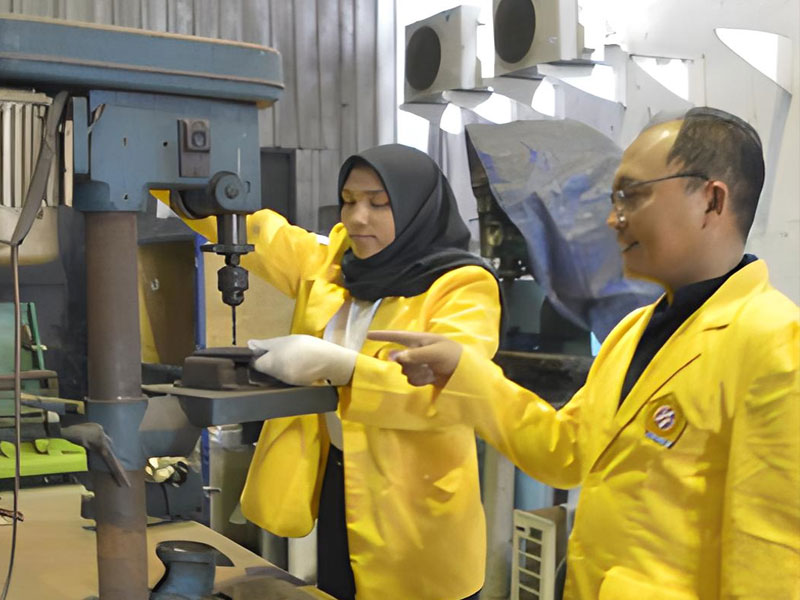
Study of Program D-3 Mechanical Engineering organizes educational process for generating power Associate Expert who has the ability in designing, machining process, the process of fabrication, maintenance, control, management of production processes and the management of engine maintenance.
Mechanical Engineering Study Program consists of concentration Engineering Machining (
Production ) and Technical Maintenance and Repair (
Machinery Maintenance ) and will be developed Concentration of Mechanical Design Engineering ( Construction Design ) and Fabrication Techniques ( Fabrication ). Development of science and technology in Mechanical Engineering Study Program is directed to the development of Powder Metallurgy, Process Integrated Machining and Machine Condition Monitoring Technology.
Competencies of Graduates of D3 Mechanical Engineering
In accordance with the existing target on the curriculum D-3 Mechanical Engineering, graduate study program is expected to have key competencies in the field of engine technology production / production processes and technology field maintenance and repair of industrial machines.Profession and Career Graduates of D3 Mechanical Engineering
Graduates of this course is absorbed in various industries, such as:- Industrial Manufacturing
- Automotive
- Textile
- Petroleum
- Industry Pertokimia
- Design
- Flight
- Services
- Electronic
- The contractor (Engineering Staff)
- Lecturer / Instructor College
While the company / place graduates work spread across many companies that have a reputation well known, such as: - PT. Garuda Indonesia
- PT. Caltex Pacific Indonesia
- PT. Pertamina
- PT. Schlumberger Indonesia
- PT. BPPT
- PT. PINDAD
| 6. Prospectus of D3 Electrical Engineering |
Associate Expert of Electrical Engineering is required in almost all areas of the workforce, especially in the face of economic liberalization in the era of globalization can not be separated from the world of electronics and electricity; need to be prepared so that the quality of human resources and is able to compete in every aspect, especially in the field of electrical engineering .Excellence & Advantage of D3 program In General
Diploma Program Three (D3) and Bachelor (S1) have their respective advantages, both are needed in the working world. Generally graduate Diploma Program Three (D3) has the designation / title "Associate Expert" abbreviated A.Md. , while the graduate program or bachelor degree (S1) has a "Bachelor" .
Excellence & Advantage of D3 program :- Study period of 6 semesters (3 years), so the faster pass than S1, and of course the total cost of their studies lighter than S1, so for people who want a quick plunge in the world of work, it is advisable to take a D3 program.
- Lecture material more applicable (practice) so it tends to be "ready to use" than S1, but it still depends on each individual.
- Need for labor to more D3 than S1, because D3 will fill the middle level in the pyramid organizational structure and management of the company.
- Etc.
Competencies of Graduates of D3 Electrical Engineering
General competencies D3 Electrical Engineering concentration of Electrical Power Engineering is to have the knowledge, ability and skills to:- Designing and installing medium voltage electrical installations to low voltage installations including specialized.
- Perform system trouble shooting electrical installations and building equipment, industrial machinery and electrical control.
- Perform maintenance and repairs to the electrical system and equipment installations and industrial buildings.
- Define equipment specifications and estimate the electrical installation work.
- Designing and implementing an industrial installation.
- Implement operation and maintenance work on electric power generation systems, electrical power systems, and electric power distribution.
- Perform a variety of electrical test equipment.
- Plan, operate, perform, supervise, control and document the work and production in the industry which it is responsible.
- Operate / care of equipment related to the electricity system.
General competencies D3 Electrical Engineering concentration of Electronics Engineering is to have the knowledge, ability and skills to:- Designing and making electronic equipment.
- Maintain and repair electronic equipment.
- Designing and operating a digital system and microprocessor-based operating system / computer.
- Installing electronic systems and supervision.
- Testing and analysis of physical quantities as well as perform on instrumentation systems.
- Design, assemble and test instrumentation and control systems in the industry
Basic competencies Associate Expert of Electrical Engineering is to have quality and intellectual integrity; highly competitive both academically and morally; able to adjust to the changes; realize that science is always advancing and evolving; able to browse and scientific information / engineering; know how and can continually learn; in addressing each issue, and was able to uncover the structure of the core problems and set priorities stages of completion; know and can take advantage of the usefulness of mathematics and information technology can apply science and knowledge; proficient and skilled in electrical engineering; able to solve problems logically, utilize data / information available; able to use these concepts to explain things that are not / less clear; able to work independently and effort; able to actively participate in working groups; able to communicate with experts in other areas of expertise and utilize their help; able to effectively utilize the resources available; able to start forming units stub entrepreneur in the field of electrical engineering, was able to follow new developments in the field of electrical engineering, conduct research , or follow the course of study at the next level.
In particular, D3 Electrical Engineering equipped with the knowledge, professional ethics, and the ability to apply electrical engineering skills are growing rapidly by utilizing information and communication technologies in the areas of:
Power Engineering, including power generation, industrial electrical installations, power installations, basic electrical installations, power distribution, power systems analysis, programming PLC, analog electronics, computer programming, power system protection, the circuit electricity, medium voltage installations, electrical design, electrical energy management, management of electricity projects, microcontroller, domestic electrical installation, maintenance & repair management, electrical machinery, measuring instruments and electrical measurements, electrical materials, power electronics, etc.
Electronics Engineering, including electronic components, microprocessor systems, sensors and transducers, industrial electronics, distributed control systems and telemetry, digital system design, intrumentasi industrial, electronic measuring instruments and measurement, continuous control systems, design and fabrication electronics systems, industrial automation systems, logic circuits, signal processing systems, analog electronics, wiring and pcb technology, mechatronics, microprocessor interface engineering, electrical circuits, digital control systems, etc.Profession and Career Graduates of D3 Electrical Engineering
Associate Expert of Electrical Engineering concentration Electronics Engineering can work and a career in government or private institutions (national and multinational), service industries (such as banking), as well as companies such as Industrial designer / producer of electronic components, industrial manufacturing , the automotive industry, oil industry, computer centers and networks, telecommunications services industry, consumer electronics industry, operator / technician television / radio operator / technician at the company's computer network telecommunications, computer services company, industrial audio / video, instructor / lecturer at educational institutions and training in electronics systems.
Associate Expert of Electrical Engineering concentration Electrical Power Engineering can work and a career in government or private institutions (national and multinational), service industries (such as banking), as well as companies such as Industrial designer / producer of electrical components, generating , transmission, power distribution, power engineering consulting services to industry, construction services, installation, maintenance and testing (inspecting) the installation of electrical power, electricity technology development, instructor / lecturer on education and training institutions in electricity; on the electric company: as the operator and maintenance of the plant, distribution substations and networks; the construction company: as the executor of the installation and maintenance of lighting and power installations; the industry: as an operator and maintenance of electrical systems; etc.
Being Entreprenuer (entrepreneurs) to establish electronic consulting services or consultants of electricity, or set up a production company contractor or electronics, or business repairs and maintenance in the field of electronics or electrical power, etc.